


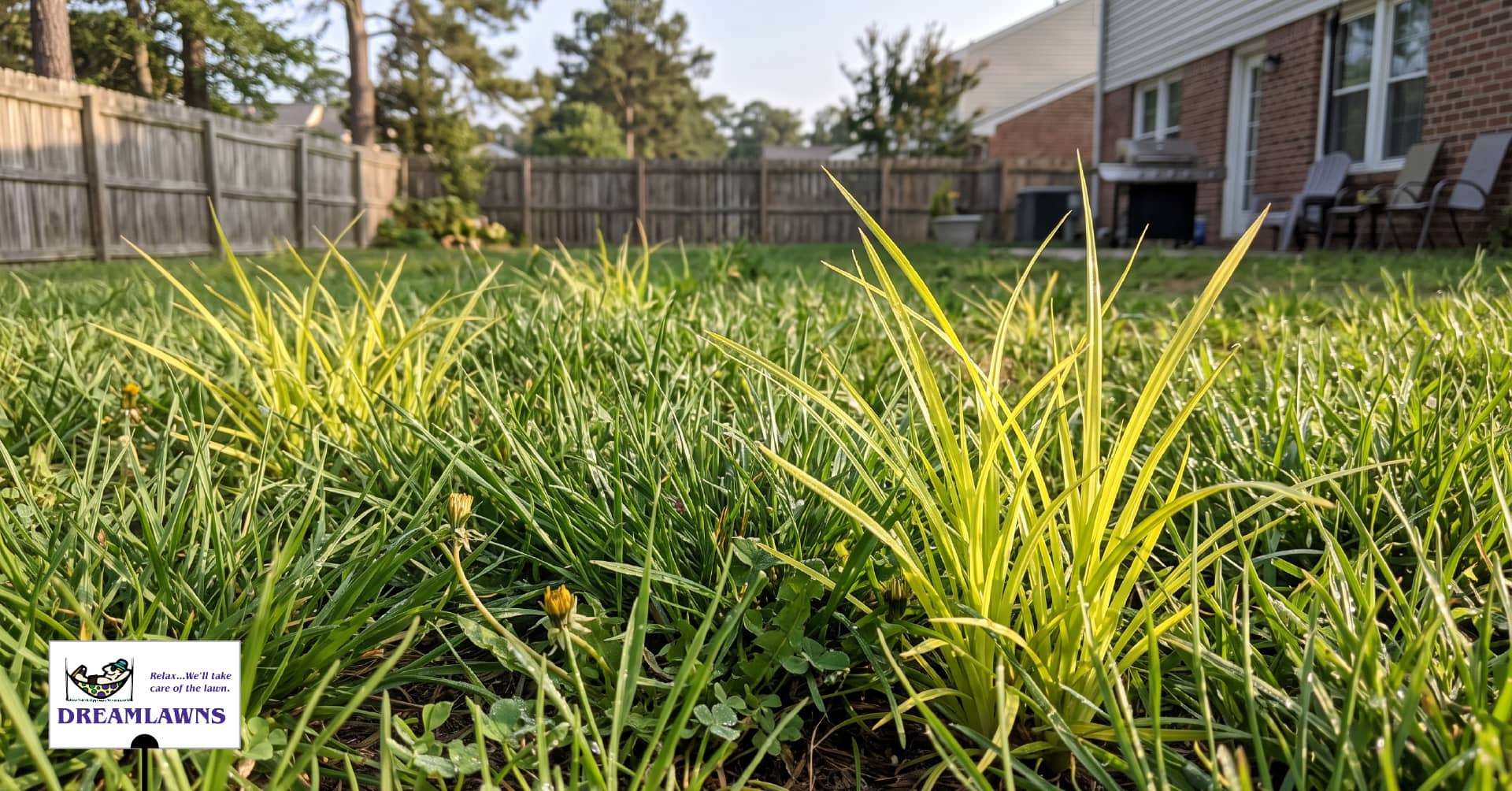
Dreamlawns Quick Cut: Nutsedge returns every year because it reproduces through underground tubers that survive treatment, mowing, and winter. A single plant can produce several hundred to several thousand of them in one season, and they stay viable in the soil for years. Pulling it leaves the tubers behind. Most consumer weed killers do not touch it because it is a sedge rather than a grass or broadleaf. Real control means sedge-specific treatment timed to early summer, repeated across multiple seasons, plus fixing the moisture and drainage problems that invite it.
You pulled it. You sprayed it. You may have done both, more than once. And every summer it comes right back, standing taller than the rest of the lawn within days of mowing, in the same spots as last year.
Nutsedge is one of the most persistent weeds in Virginia Beach lawns, and the reason has almost nothing to do with how hard you have worked at it. The part of the plant you see above ground is not the part that matters. The real problem is underground, and by the time nutsedge is visible in your lawn, that underground problem is already well established.
This guide explains why nutsedge keeps returning season after season, why the two most common responses to it fail, and what a control program that actually works looks like. Fair warning, the honest answer involves a longer timeline than most homeowners expect.
What Makes Nutsedge Different From Other Lawn Weeds?
Most lawn weeds fall into two categories. Broadleaf weeds like chickweed and henbit, and grassy weeds like crabgrass. Nutsedge is neither. It is a sedge, a grass-like perennial with a triangular stem and shallow rhizomes that produce nut-like tubers. Roll a stem between your fingers, and you will feel three distinct edges, which is the quickest field test there is.
That classification is not trivia. It is the single reason most weed control efforts against nutsedge fail, because products formulated for broadleaf or grassy weeds frequently have little effect on sedges. See our page on what nutsedge is.
The other distinguishing trait is how it reproduces. Nutsedge spreads primarily by tubers rather than by seed. That underground reproduction strategy is what makes it a recurring problem rather than a one-season nuisance, and it is where the rest of this guide focuses.
Why Does Nutsedge Keep Coming Back Every Year?
The answer is tubers, the small underground structures that give nutsedge its name. These nutlets form at the ends of underground stems called rhizomes, and they are the plant’s survival system.
The numbers explain everything about why this weed is so hard to shake:
- A single plant can produce several hundred to several thousand tubers in one growing season
- Tuber production begins in mid-summer, with tubers starting to form in July
- Most of them sit in the top six inches of soil, exactly where new shoots can emerge easily
- They stay viable for years. Research reports range from about three years under ideal conditions to up to three and a half years, with some sources documenting considerably longer
Now consider what winter does. Frost kills the plant but not the tubers it produced. The visible nutsedge in your lawn disappears every fall, and every one of those plants leaves behind a bank of tubers sitting in the top few inches of soil, waiting for warm weather.
This is why nutsedge feels like it comes back from nothing. It is not returning from nothing. It is returning from a reserve that was built up over previous summers and that no amount of surface-level effort has touched.
Why Doesn’t Pulling Nutsedge Work?
Hand-pulling is the most common response to nutsedge and one of the least effective. Pulling will help eliminate the visible weeds but will not remove the tubers in the soil, and the tubers are the entire problem.
What actually happens when you pull nutsedge is that you remove the top growth while leaving the underground network intact. The tubers remain, and they sprout new shoots. In many cases, homeowners find the patch looks worse a few weeks later, because removing the established plant releases dormant tubers that were being suppressed by the parent plant to produce growth of their own.
There is a narrow exception. In landscape beds, where you can dig rather than pull, removing the entire plant, including the root and rhizome system, by digging around the base can work on a small number of plants. In turf, that is not practical without tearing up the lawn, and it still leaves behind any tubers that have detached from the parent plant.
Why Don’t Store-Bought Weed Killers Work on Nutsedge?
This is the second thing homeowners try, and the second thing that usually disappoints. The explanation goes back to classification. Because nutsedge is a sedge rather than a broadleaf or a grass, products built for the weeds most people deal with often have little effect on it. Spraying a general-purpose lawn weed killer on nutsedge frequently produces no visible result at all.
Even with a product that does target sedges, there is a limitation worth understanding clearly. Herbicide applications injure growing nutsedge plants and help prevent more tubers from forming, but they do not control tubers that are viable in the soil and have not yet produced plants.
Read that twice, because it explains the entire frustration. Treatment works on what is growing. It does nothing to the dormant reserve underground. You can get a complete kill on every visible plant in your lawn and still have thousands of viable tubers waiting for next June. That is not a product failure. It is the nature of the weed.
What Conditions Let Nutsedge Thrive?
Nutsedge is opportunistic, and certain lawn conditions roll out the welcome mat. Addressing these matters as much as any treatment.
- Excess moisture and poor drainage: Nutsedge favors damp soil and low spots that stay wet. Correcting drainage problems gives turf better conditions to outcompete it and other moisture-loving weeds.
- Overwatering: Chronically overwatered lawns create the damp conditions nutsedge prefers, which is one more reason watering practices matter.
- Thin turf: It is a mistake to assume nutsedge only shows up in wet areas. It is also a problem in well-drained areas, especially thin turf, where there is open ground and light reaching the soil.
- Compacted soil: Compaction causes water to sit at the surface and weakens turf density, creating both conditions nutsedge exploits.
- Contaminated topsoil: Tubers spread easily when soil containing them is moved from one area to another. A new infestation in a previously clean lawn often traces back to soil brought in for a landscaping project.
One useful detail from the research is that shaded conditions severely limit tuber production. A dense, healthy stand of turf that shades the soil surface is not just competing with nutsedge for resources. It is actively suppressing the underground reproduction that drives next year’s infestation.
What Actually Works for Nutsedge Control?
Effective nutsedge control comes down to three things: the right product, the right timing, and a realistic timeline. Miss any one of them, and you are back where you started.
Timing Matters More Than Anything
The ideal window is early summer, when the plant is young and actively growing. At that stage, nutsedge has not started producing tubers yet and is most susceptible to herbicides. Treating then does double duty. It controls the plant you can see, and it prevents that plant from banking tubers for next year.
Treat too late, after tuber production is underway, and you may kill the visible plant while the tubers it already produced survive untouched. This is the same timing principle that governs most weed control, as we cover in our guide to the life cycle of a weed. With nutsedge, the stakes are just higher, because the reproductive structures persist for years rather than a single season.
It Takes More Than One Season
Here is the part most homeowners are never told. Two to three years of control using herbicides will be needed to reduce viable tubers in the soil by 90 percent.
That is the honest timeline. Not one application, not one summer. A sustained program across multiple growing seasons that keeps killing new shoots before they can replenish the tuber bank, gradually drawing down a reserve that took years to build. Anyone promising to eliminate an established nutsedge infestation in a single treatment is not describing how this weed works.
Turf Density Does the Rest
Treatment draws down the tuber bank. Healthy turf keeps new nutsedge from establishing in the space that opens up. Correcting drainage, relieving compaction, watering properly, and maintaining a thick stand of grass all work against nutsedge at the same time, and they are what keep the problem from rebuilding once you have gained ground on it.
Why Fall Is When You Should Be Planning for Next Year
By fall, the nutsedge in your lawn is finishing its season. The visible plants will die back with the first frost, and the lawn will look clean through winter. It is easy to assume the problem resolved itself.
It did not. Every nutsedge plant that grew in your lawn this year has already produced its tubers, and frost kills the plant but not those tubers. Next summer’s infestation is effectively set, sitting dormant in the top few inches of soil. Nothing you apply in October changes that.
What fall is genuinely good for is planning. If nutsedge has been a recurring problem in your lawn, the time to act is before it emerges next year, with a program timed to the early summer window and built to run across multiple seasons rather than reacting to what pops up in July. Homeowners who wait until they see it again next summer have already missed the most effective part of the window, which is exactly how the cycle repeats itself year after year.
How Does Dreamlawns Handle Nutsedge?
We treat nutsedge as a multi-season problem, because that is what the science says it is. Our weed control program uses products selected specifically for sedges rather than general-purpose lawn weed killers, applied on a schedule timed to the early summer window when the plant is most vulnerable and before it banks tubers for the following year. Nutsedge control is included in our turf program at no additional cost. Many companies in the area sell it as a separate program with an added fee, so it is worth asking about when you compare providers. Since control takes multiple seasons to work, having it built into your program from the start means you are not paying extra to stay on schedule.
If nutsedge has been coming back in the same spots every summer, now is the right time to build a plan for next season. Contact us today to schedule a property assessment and get ahead of it before it emerges again.
Frequently Asked Questions
No. Nutsedge control is included as part of our turf program at no additional cost. Many area companies offer it as a separate program for an added fee. Because nutsedge typically takes two to three seasons of consistent treatment to bring under control, including it in the core program means you can stay on schedule without a second bill.
Because it reproduces through underground tubers that survive everything happening above ground. A single plant can produce several hundred to several thousand tubers in one growing season, they sit in the top six inches of soil, and they remain viable for years. Frost kills the plant but not the tubers, so each winter the visible weed disappears while the underground reserve stays intact and ready to sprout the following summer.
Pulling is generally not effective in a lawn. It removes the visible weeds but does not remove the tubers in the soil, and those tubers simply produce new shoots. In many cases the patch looks worse a few weeks later as dormant tubers are released to grow. In landscape beds, digging out the entire plant including the rhizome system can work on a small number of plants, but in turf that is not practical.
Usually not. Nutsedge is a sedge rather than a broadleaf or grassy weed, and most general-purpose lawn weed killers are not formulated to control sedges. Even products that do target sedges have a limit worth understanding: they injure actively growing plants and prevent new tubers from forming, but they do not kill dormant tubers already sitting in the soil. That is why a single successful treatment still leaves next year’s infestation intact.
The visible plant does. Frost kills the plant but not the tubers it produced during the summer.. Those tubers overwinter in the soil and sprout when warm weather returns, which is why a lawn that looks completely clean in January can have nutsedge in the same spots by the following June. The winter disappearance is not recovery, it is dormancy.
Lawn Care Services In The Virginia Beach Area
Dreamlawns provides superior lawn care service to Virginia Beach & Chesapeake VA residents.

