


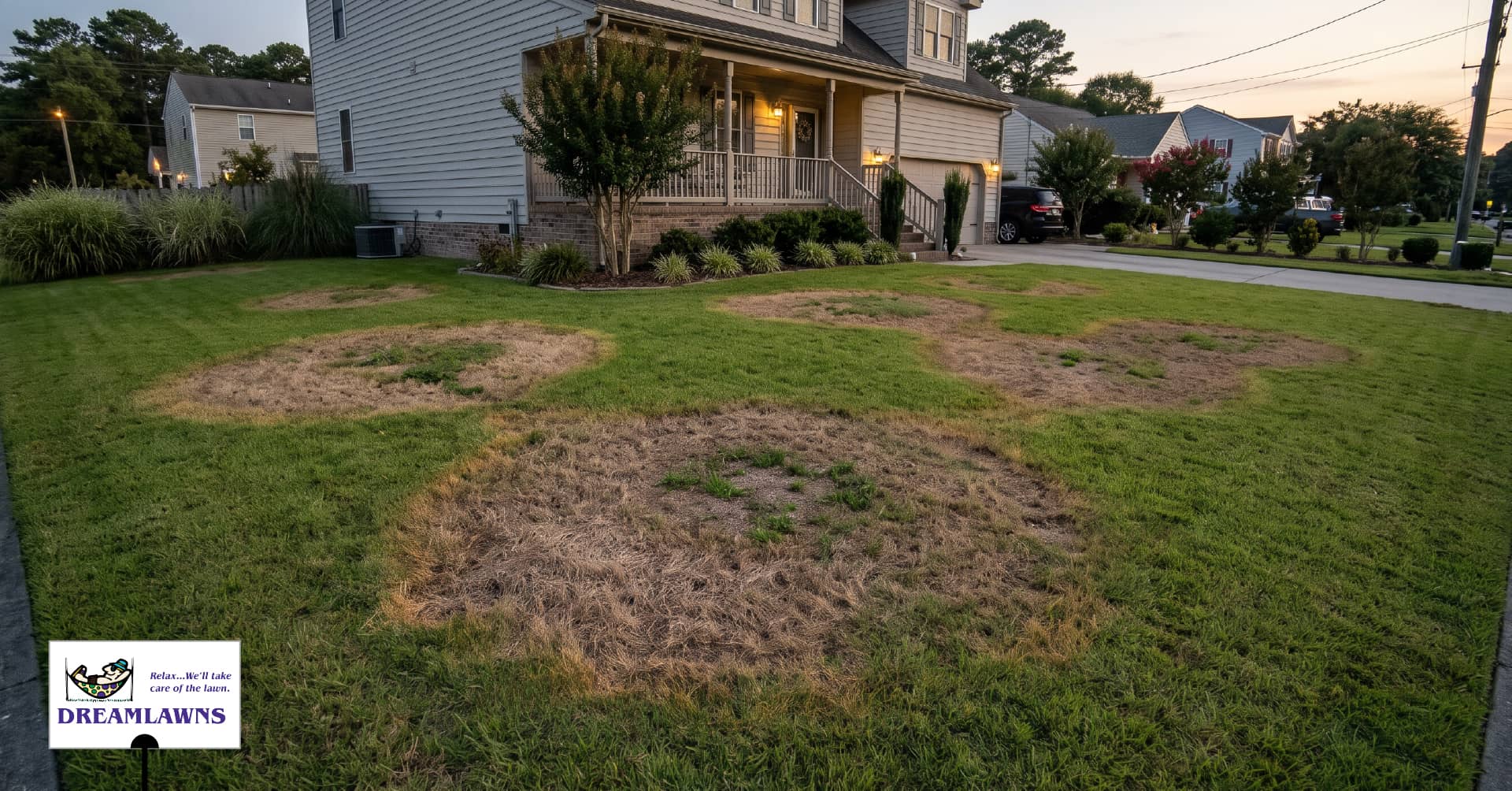
Dreamlawns Quick Cut: Large patch is a fungus that infects Zoysia and St. Augustine lawns in the fall, but the tan circles usually do not show up until spring. By then, treatment works poorly, which is why prevention matters more than repair. Fungicides must go down before patches appear, as fall soil temperatures begin to drop. Less nitrogen in fall and spring, watering only as needed, and controlling thatch and drainage all lower the risk. The roots and runners usually survive, so affected lawns typically recover, but it can take months.
Every spring, some Virginia Beach homeowners with Zoysia or St. Augustine lawns find tan circles that were not there last fall. The grass is not dead, and the problem did not start this spring. It started months earlier, when the weather cooled, and the grass was slowing down for winter.
That timing is what makes large patch frustrating. By the time you can see it, treatment is much less effective than prevention. The good news is that prevention is manageable, and most of it is about habits you already control.
This guide explains what large patch is, which grasses get it, why a fall infection looks like a spring problem, what you can do in fall to prevent it, and what to expect if it already struck your lawn.
What Is Large Patch?
Large patch is a turf disease caused by the fungus Rhizoctonia solani. It is easy to recognize in a yard: roughly circular patches that range from a few inches to several feet across, typically tan in color, sometimes with an orange-red edge. The grass in the center may start to recover, which leaves a ring.
Patches may reach 20 feet in diameter, and the dead-looking centers can look thin and sunken and may be invaded by weeds.
One reassurance is worth knowing up front. Large patch has infrequently been observed on warm-season turf in Virginia, so it is not a certainty for every lawn. It is worth knowing about if your lawn has had patches before, or if you grow the grasses that are most prone to it.
Which Grasses Get Large Patch?
Not all warm-season grasses are equally at risk. Centipedegrass and seashore paspalum are the most susceptible, followed by zoysiagrass and then St. Augustinegrass. Bermudagrass is rarely affected and recovers very quickly when the disease does occur, and zoysia is more susceptible to large patch than Bermuda.
For Virginia Beach homeowners, that mostly means zoysia and St. Augustine lawns. St. Augustine deserves a note of its own. It is adapted primarily to southeast Virginia, where the ocean moderates the climate, and it has the poorest cold tolerance of the warm-season grasses grown in Virginia. That makes it a coastal grass here, with less margin than the others.
Tall fescue has no such problem. Fescues and bluegrasses are immune to large patch.
Why Does Large Patch Show Up in Spring if It Starts in Fall?
This is the part that surprises people. Infection occurs in the fall when soil temperatures stay below 70°F, but the symptoms do not necessarily appear at that time. They typically show up in spring, as the infected turf comes out of dormancy.
Near the coast, the infection window can run long. In coastal North Carolina, large patch continues to infect and spread through the fall and even into winter. That is the nearest regional evidence for Hampton Roads.
Then the spring cycle begins. Once soil temperatures climb above 50°F, the fungus becomes active again and can re-infect the grass, and the patches that were quietly forming all winter show up as the lawn greens up.
The practical lesson is simple. By the time the damage appears at spring green-up, it is too late to do anything about it.
What Conditions Bring On Large Patch?
Most of the risk factors are things you can influence: excessive nitrogen in fall and spring, poor soil drainage, over-irrigation, excessive thatch, and low mowing heights.
- Wet leaves: Infection happens when the thatch layer is between 50 and 70°F and moisture stays continuous for at least 48 hours.
- Low mowing: On zoysia, severity rises as mowing height drops from 1.5 to 0.5 inches, and the disease is more severe on zoysia mowed below one inch.
- Poor drainage and thatch: Both keep the base of the plant wet, which favors the disease.
Poor drainage often starts with soil compaction, and over-irrigation leaves clear signs in the lawn.
How Is Large Patch Different From Spring Dead Spot?
Both are fall-first diseases of warm-season lawns. Spring dead spot is the one to watch on Bermuda, and like large patch, you treat it in fall, not spring. Large patch is the one to watch on zoysia and St. Augustine.
The advice is the same for both. Turf with a history of large patch should be treated chemically in the early fall to maximize control. The common thread is that the fall, not the spring, is when the fight happens.
What Can You Do in Fall to Prevent Large Patch?
Prevention has two parts, habits and timing.
Habits That Lower the Risk
- Hold back nitrogen: Skip nitrogen on warm-season grasses in the six weeks before fall dormancy and the three weeks after spring green-up. The last nitrogen for St. Augustine should go down no later than one month before the anticipated frost date, and zoysia should be fertilized only during its most active growing months.
- Water only as needed: Irrigate only as needed to prevent severe drought stress in fall and spring.
- Fix drainage and manage thatch: Aerate as needed to maintain drainage, and power rake or vertical mow as needed to control thatch.
- Time the cultivation: Don’t core aerate or verticut in spring while large patch is active, because it spreads the disease. Do those jobs in summer instead. Fall is also too late to safely aerate warm-season grass.
- Mow at the right height: Keep the mowing height consistent and correct for your variety of turf.
Timing Matters for Fungicide
Fungicide is a tool for prevention, not repair. Large patch fungicides must be applied preventively, when soil temperatures drop below 70°F for several consecutive days in the fall. In North Carolina, the trigger for zoysia is 70°F for five or more consecutive days, and for St. Augustine it is 80°F for five or more consecutive days, which could be mid-August in some years.
Waiting for patches to appear costs you. Fungicide applications after patches start to develop are much less effective than preventive applications.
Here is the honest caveat for Virginia Beach. Virginia’s extension guidance gives no soil temperature trigger or calendar for this disease, only “early fall.” The temperature triggers above come from North Carolina, the nearest coastal data. By November, most of the guidance above puts this year’s preventive window behind us, so the best use of this information is next year’s plan.
One tip saves money. Mapping the affected areas in spring and spot-treating them in fall can substantially reduce fungicide costs. If you see patches this spring, mark where they are.
What Should You Expect in Spring if Large Patch Hit Your Lawn?
Expect patience to be part of the answer. Spring fungicide at green-up may help reduce severe infections, but it will not provide a fast miracle cure once symptoms are present, and curative spring fungicide applications are not recommended.
The encouraging news is about recovery. The disease is not known to kill stolons or roots, so the turf recovers by forming new shoots once the weather warms. How long that takes varies, and recovery can take several weeks or months.
In the meantime, wait to apply nitrogen until warm weather has slowed large patch development, usually May. Excess nitrogen in spring is one of the conditions that favor the disease.
How Does Dreamlawns Handle Warm-Season Lawns in Fall and Winter?
We build our programs around the season and the grass. Our warm-season TurfCare Program is a six-round program that includes one fungicide application to reduce winter disease, along with gentle liquid nutrient applications. We also recommend preventive disease and insect control for every St. Augustine lawn.
If your zoysia or St. Augustine lawn had tan circles last spring, tell us where they were and when you noticed them. That information is the most useful thing a homeowner can bring us, because it helps us plan around the fall window instead of reacting in the spring.
Ready to get ahead of next spring? Contact us today to schedule a property assessment and talk through what your warm-season lawn needs this year and next.
Frequently Asked Questions
Large patch is a fungal disease caused by Rhizoctonia solani that creates roughly circular tan patches, sometimes with an orange-red edge, ranging from a few inches to several feet across. Infection occurs in the fall, but the patches usually appear in spring as the lawn greens up. Zoysia is more susceptible than Bermuda.
Fungicide has to go down preventively in the fall. Lawns with a history of the disease should be treated in early fall. In coastal North Carolina, the timing is tied to soil temperatures, with Zoysia treated when soil temperatures drop to 70°F for five or more consecutive days. Virginia guidance gives no specific calendar, so check your soil temperature and ask a professional.
Usually not. The disease is not known to kill the stolons or roots, so the grass sends up new shoots as the weather warms. Recovery can take weeks or months, and patches in areas that drain poorly or get heavy traffic may need repair.
Spring treatment is much less effective. Spring fungicide at green-up may help reduce severe infections but will not work as a fast cure, and curative spring applications are not recommended. Better spring steps are holding back nitrogen until warm weather arrives and avoiding core aeration while the disease is active.
It can. Symptoms frequently reappear in early spring in the same locations as the fall patches. That is why mapping the patches in spring and preparing for the next fall window is a sound plan for lawns with a history of the disease.
Lawn Care Services In The Virginia Beach Area
Dreamlawns provides superior lawn care service to Virginia Beach & Chesapeake VA residents.

