


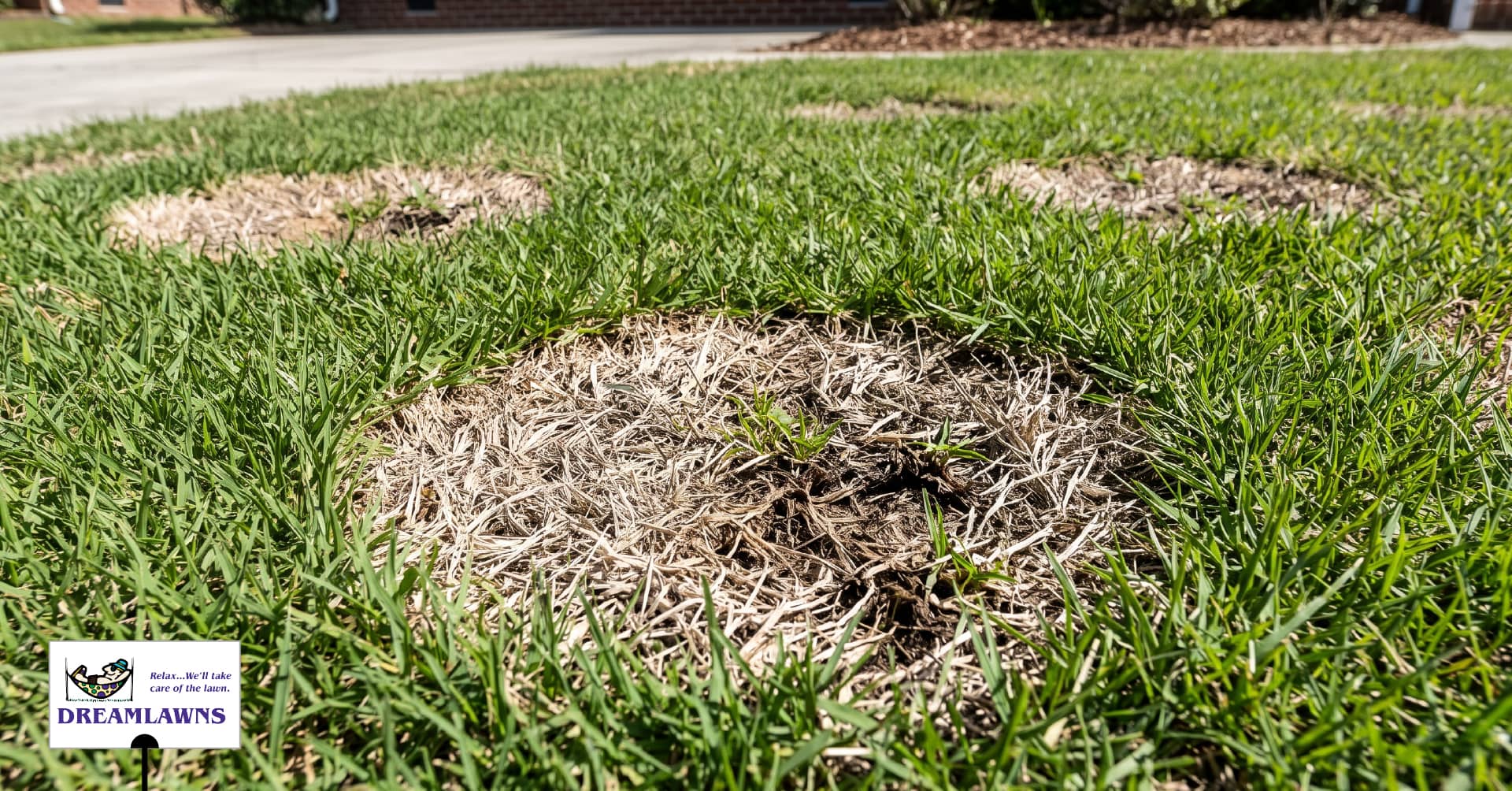
Dreamlawns Quick Cut: Spring dead spot is the most destructive disease of Bermuda lawns in Virginia Beach, and the name is misleading. The infection happens in fall, not spring. Fungi colonize the roots and runners as soil temperatures drop, weakening the plant so winter cold kills it. You see the damage at green-up, months after the window to prevent it has closed. Fungicide has to go down in fall, timed to soil temperature rather than the calendar.
Your Bermuda lawn goes dormant in good shape. Then spring arrives, the lawn starts greening up, and circular patches of dead, bleached turf appear scattered across the yard. They have sharp edges. The grass around them is coming back fine. The patches are not.
That is spring dead spot, and it is the most damaging disease Bermuda lawns face in climates like ours where the grass goes dormant each winter. It is also one of the most misunderstood, because the name describes when you see it rather than when it happens.
The infection took place the previous fall. By the time those patches appear at green-up, the window to do anything about them closed months earlier. This guide explains why that is, what is actually happening underground, and when treatment needs to happen if you want a different result next spring.
What Is Spring Dead Spot?
Spring dead spot is caused by several soil-borne fungi in the Ophiosphaerella genus. It is the most detrimental disease to warm-season turfgrasses in areas with cold-induced dormancy, which describes Virginia Beach precisely. Our Bermuda goes fully dormant every winter, and that dormancy is part of what makes the disease so damaging here.
The symptoms are distinctive once you know them. Multiple circular patches of dead, bleached grass appear in spring, with sharp edges between the dead and healthy turf as the lawn greens up. The patches often return in roughly the same locations year after year, expanding outward over time if nothing changes.
It is worth distinguishing this from normal dormancy. Dormant Bermuda is uniformly tan across the whole lawn and greens up together. Spring dead spots show as defined circles that stay dead while everything around them recovers. If you are unsure which you are looking at, our guide on dormant versus dead grass covers how to tell.
Why Does a Fall Disease Show Up in Spring?
This is the part that confuses most homeowners, and understanding it changes how you approach the whole problem.
The fungi do not kill bermudagrass directly. Instead, they make the turf more susceptible to cold and freezing injury by feeding on roots, rhizomes, and stolons. The disease is not what kills the grass. Winter is. The fungus just removes the plant’s ability to survive it.
The sequence runs like this. As fall arrives and soil cools, pigmented fungal growth begins colonizing the outside of the roots, rhizomes, and stolons of Bermuda plants once soil temperatures drop to roughly 70 degrees, and continues until soil temperatures reach about 50 degrees. Through that window, the root system is quietly being compromised. The lawn above ground looks fine and then goes dormant on schedule, so nothing appears wrong.
Then winter does its work. The plants with damaged root systems cannot handle the cold, and they die. The lawn stays brown through dormancy, so you still see nothing. Only at green-up, when the healthy turf comes back and the dead patches do not, does the damage become visible. By then it is five or six months old.
Why Can’t You Treat Spring Dead Spot in Spring?
By spring, you are looking at a result, not a problem in progress. The plants in those patches are already dead. No fungicide brings them back, and the infection that killed them finished months earlier.
The research backs this up directly. A single spring application is generally not effective, though a spring application paired with a fall application can perform comparably to two fall treatments. On its own, spring treatment is largely wasted effort and money.
What spring is genuinely good for is two things. First, encouraging recovery, since Bermuda spreads aggressively and can fill in damaged areas during the growing season with proper care. Second, and more importantly, mapping. Spring is when you can see exactly where the disease is, and that information is what makes the following fall’s treatment effective.
When Should Fungicide Actually Go Down?
Fall, and specifically timed to soil temperature rather than a date on the calendar. This distinction matters more than most homeowners realize, because warm fall weather can push the right window weeks later than the traditional calendar timing would suggest.
The Established Window
Conventional guidance starts applications as soil temperatures decline through the 70-degree mark, which is when infection begins. Applications should go down in the fall before soil temperatures drop below 70 degrees, and a second application 30 days later produces better control than a single treatment. Research has shown a fall application made when soil temperatures are between 60 and 80 degrees provides the best control.
What Virginia Research Adds
Work done specifically in Virginia sharpens that picture. A field study at three hybrid Bermuda locations in the state found that fall applications made when soil temperatures were near 55 degrees consistently provided the best suppression. The same research notes that relying on calendar dates alone, rather than considering both soil temperature and time of year, is a major reason fungicide results have been inconsistent.
The practical takeaway for a Virginia Beach Bermuda lawn is that the treatment window opens as soil temperatures fall through the 70s and runs into the cooler part of fall, with the back half of that window likely doing the most work. Monitoring soil temperature is what makes the difference between a well-timed application and an expensive guess.
What Else Reduces Spring Dead Spot Severity?
Fungicide is one piece. The cultural side matters as much, and several of these overlap with good Bermuda care generally.
- Fall potassium: Potassium applied in September or October improves the winter hardiness of Bermuda and reduces spring dead spot severity, and should be applied based on soil test results. Since the disease kills by making plants vulnerable to cold, anything that improves cold hardiness works directly against it.
- Hold late-season nitrogen: Nitrogen applied too close to dormancy pushes tender growth that will not harden off before cold arrives, working against the winter hardiness you are trying to build.
- Manage thatch and compaction: Any soil condition that reduces Bermuda root growth, including compaction and excessive thatch, makes the disease worse. Relieving soil compaction supports the root system the fungus is attacking.
- Maintain proper soil pH: Keeping soil pH in the appropriate range supports plant vigor. Worth noting, though, that the disease occurs across a range of soil pH levels, and acidifying soil specifically to control it is not currently recommended.
Why Does Spring Dead Spot Take More Than One Season?
Because this is a difficult disease and acceptable control is rarely achieved quickly. It typically takes two to four years of proper cultural management and fungicide applications before acceptable control is reached.
That timeline is worth knowing before you start, because one fall of treatment followed by a spring that still shows patches feels like failure when it is actually normal progress. The disease builds in the soil over years, and drawing it down takes a sustained program rather than a single intervention.
There is also a practical constraint for homeowners doing this themselves. Few effective fungicides are available for homeowner use against spring dead spot. The products with the strongest research behind them are largely professional materials, which is a real limitation on the do-it-yourself approach to this particular disease.
Why Does Mapping the Patches Matter?
This is a small step with outsized value, and it is the one thing you should do the moment you see the patches next spring.
Spring dead spot tends to recur in the same places. Photographing or otherwise mapping the affected areas in spring, then targeting fall fungicide applications to only those areas where the disease was present, concentrates the treatment where it will actually do something rather than spreading it thin across a whole lawn.
Without that record, fall treatment is guesswork. The lawn is dormant or heading there, the patches are invisible, and there is no way to know which areas carry the history. A few photos taken at green-up, with something in frame for reference, turn the next fall’s application into a targeted treatment.
How Does Dreamlawns Handle Spring Dead Spot?
We treat spring dead spot as a fall program, because that is the only time treatment does anything. Applications are triggered by soil temperature rather than a fixed date on a schedule, since warm falls shift that window and a calendar-based application can easily miss it entirely. For Bermuda lawns with a known history, that means monitoring conditions and applying when the turf is actually susceptible.
We also work the cultural side alongside the fungicide. Fall potassium timed to support winter hardiness, holding nitrogen as dormancy approaches, and addressing the compaction and thatch that restrict root growth all reduce severity, and they are part of how we manage Bermuda lawns through the year rather than separate add-ons. You can see how disease management fits the broader picture in our overview of common lawn diseases in Virginia Beach.
And we are upfront about the timeline. Meaningful control of an established spring dead spot problem takes multiple seasons of consistent work. We would rather set that expectation at the start than have a homeowner conclude after one fall that the program did not work.
If your Bermuda lawn had dead circles at green-up this year, fall is when you do something about next spring. Contact us today to schedule a property assessment and get a plan in place while the window is open.
Frequently Asked Questions
Soil-borne fungi in the Ophiosphaerella genus cause it. They become active in cool, moist fall conditions and feed on roots, rhizomes, and stolons, making the turf more susceptible to cold and freezing injury rather than killing it outright. Winter cold then kills the weakened plants. The circular dead patches become visible the following spring at green-up, which is where the disease gets its misleading name.
Not effectively on its own. The plants in those patches are already dead, and the infection finished months earlier, so a single spring application is generally not effective. Spring is better used for two things: supporting recovery so healthy Bermuda can fill in the damaged areas, and mapping where the patches are so the following fall’s fungicide can be targeted to those exact spots.
In fall, timed to soil temperature rather than the calendar. Applications traditionally begin as soil temperatures decline through 70 degrees, with a second application 30 days later giving better control than a single treatment. Research conducted in Virginia found that fall applications near 55 degrees soil temperature consistently provided the best suppression. Warm falls can push the right window later than expected, which is why monitoring soil temperature matters.
Without treatment, yes, and it tends to recur in the same locations and expand outward over time. Even with treatment, this is not a one-season fix. It typically takes two to four years of proper cultural management and fungicide applications before acceptable control is achieved. Consistency across seasons is what reduces it, not any single application.
Recovery and prevention are separate jobs. For existing patches, healthy Bermuda can spread into damaged areas during the growing season with good care, including balanced fertility to speed recovery and help the turf outcompete weeds moving into the bare spots. For prevention, the work happens the following fall with properly timed fungicide, fall potassium to improve winter hardiness, and attention to thatch and compaction. Fixing the patches you have and preventing next year’s are two different efforts on two different schedules.
Lawn Care Services In The Virginia Beach Area
Dreamlawns provides superior lawn care service to Virginia Beach & Chesapeake VA residents.

